
Lebohang Kganye (b. 1990, South Africa) works with expanded photography, video and mixed media to create works that layer historiography, research, theatricality, autobiography and poetics in often sculptural installations. The artist’s family name is etymologically linked to the Sotho word for light, “kganya”; bringing light to layered postcolonial histories is an animating thread in her practice.
Kganye is featured in MoMA New Photography 2025. Her recent touring solo exhibition, Le Sale ka Kgotso, debuted at the Fotografiska, Berlin (2025), and features newly commissioned work. She is the recipient of the 2024 Deutsche Börse Foundation Prize for her solo exhibition at Foam (2023). Other notable recent awards include the ICP Infinity Award, 2025, the Foam Paul Huf Award, 2022 and the Camera Austria Award, 2019.
The artist has recently exhibited at the Albertina Museum, Tate Modern, the Art Institute of Chicago, LE BAL, the Barnes Foundation, and other notable institutions. In 2022, Kganye exhibited in the South African Pavilion at the Venice Biennale.
Kganye’s work is held in collections including the Museum of Modern Art, the Metropolitan Museum of Art, the Centre Pompidou, the Smithsonian National Museum of African Art, the Victoria and Albert Museum, Musée d’Art Moderne de Paris, the Museum of Fine Arts Houston, the Getty Museum, and the Chazen Museum, among others.Lebohang Kganye complicates understandings of traditional mediums such as sculpture and photography. In this undertaking, she gestures towards newer, emerging forms of both photography and sculpture-making to introduce photo-sculpture at least within her own artistic repertoire.
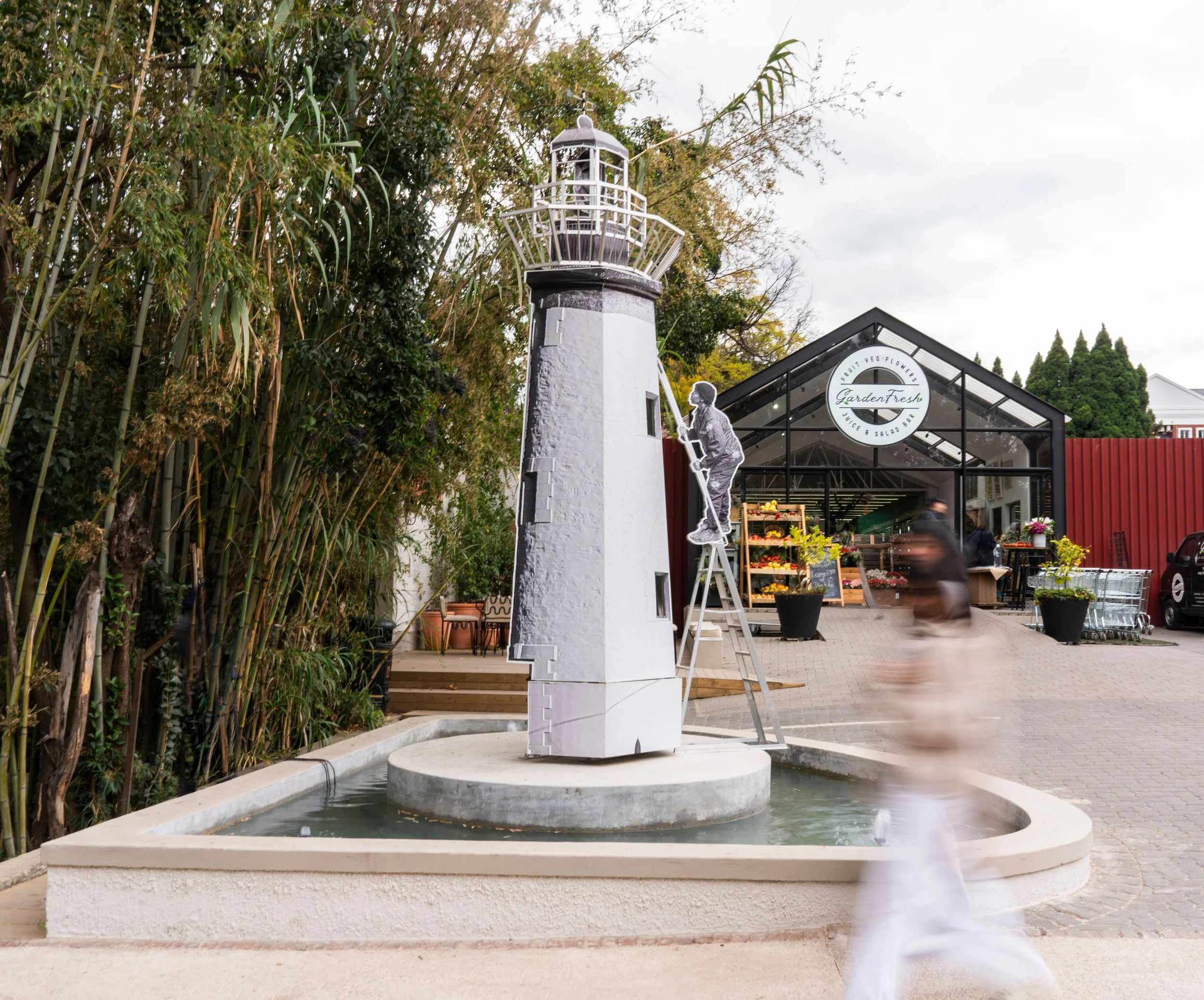
Inspired by pop-up books, this body of work consists of three large scale, three-dimensional scenes displayed as a pop-up book installation, engaging her long-term practice of world-building and (re)staging, to explore the materiality of photography. The sculptures are made from photographs printed on steel, giving them a monumental, yet layered and permeable, quality.
Drawn from her series Keep the Light Faithfully, the sculpture ‘Prisoner doing the general work’ is one from a body of work that revisits the personal and collective stories of seven lighthouse keepers who served along the South African coastlines of the Western Cape, Northern Cape, and Eastern Cape. The works are an extension of Kganye's exploration of South African history and storytelling, drawing on oral tradition to reinterpret the past. Kganye melds the fantastical, the political, and the intimate. The Sea is History is rooted in specific post-Apartheid realities, but it calls, out with a clear voice across the world, confirming once again that history is always local as well as global.
The title itself is a nod to Derek Walcott's poem "The Sea is History," which examines the relationship between history, memory, and recording the past. The installations function like a physical, walkable story-book, with each sculpture presenting a different scene. Through this medium, Kganye explores themes of identity, migration, and the constructed nature of history. The sculptures blur the lines between photography and theatre to create a dynamic, self-reflective narrative.